LED Strip 12 V or 24 V: Which to Choose and Why
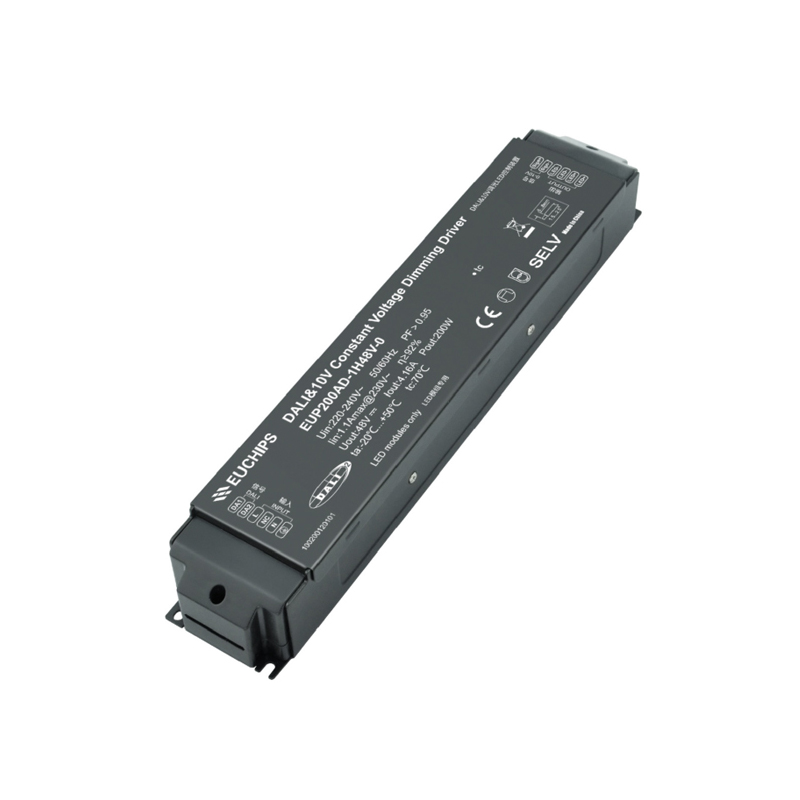
For homes and most projects a 24 V LED strip is the better choice, while 12 V suits short runs of up to about 5 m. The key difference is voltage drop: on a 12 V strip it becomes noticeable after roughly 5 m, on a 24 V strip after roughly 10 m, and for the same power a 24 V strip draws half the current. This guide explains how to choose the voltage, the power supply, the aluminium profile and the diffuser.
12 V or 24 V: how they differ
Both are low-voltage strips fed by a power supply that converts 230 V to 12 V or 24 V direct current. The difference appears as the strip gets longer: the same power at a higher voltage needs less current, and less current means smaller losses in the cables and in the copper tracks of the strip.
| Feature | 12 V strip | 24 V strip |
|---|---|---|
| Voltage drop becomes visible after | ~5 m | ~10 m |
| Current at a 72 W load | 6 A | 3 A |
| Recommended single run | up to ~5 m | up to ~10 m |
| Suits | Short runs, niches, furniture | Longer runs, ceiling coves, a whole room |
| Cable thickness on a long run | Thicker cable needed | Thinner cable is enough |
Current follows I = P / U: 72 W at 12 V is 6 A, while at 24 V it is 3 A. This simple physics is why 24 V is chosen in most cases.
Voltage drop and maximum length
Voltage drop is the dimming or colour shift you see at the far end of a strip: the further from the power supply, the lower the voltage, so the LEDs glow weaker. The resistance of the copper tracks is small, but over a long run it adds up.
Practical limits
It is usual to limit a single 12 V run to about 5 m and a 24 V run to about 10 m. For longer lines, feed the strip from both ends or split it into several sections, each with its own power connection. Use thicker cable between the supply and the start of the strip, because that cable has losses too.
What to do with a very long line
For a 15 m line of 24 V strip, do not use one piece: divide it into three 5 m sections and feed each separately from a shared supply. Brightness stays even and the layout is more flexible.
Power in W/m and choosing the power supply
LED strip power is given in watts per metre (W/m). Typical values are 4.8, 9.6 and 14.4 W/m, but always check the exact figure in the manufacturer's data. Total power is W/m multiplied by the strip length.
The power supply should have about 20 % power reserve. Example: 5 m of strip at 14.4 W/m uses 72 W; with the reserve you need at least 86.4 W, so choose a 100 W supply. A supply running at its limit heats up and has a shorter life. Our guide How to choose an LED power supply goes into more detail.
| Strip length | Power at 9.6 W/m | With 20 % reserve |
|---|---|---|
| 2 m | 19.2 W | 23 W |
| 5 m | 48 W | 57.6 W |
| 10 m | 96 W | 115.2 W |
The supply voltage must match the strip voltage: never connect a 12 V strip to a 24 V supply, as it will overheat and fail, while a 24 V strip on a 12 V supply will glow dimly or not at all.
Aluminium profile and diffuser
It is recommended to stick an LED strip into an aluminium profile. The profile does two jobs: it carries heat away, so the LEDs keep their luminous flux for longer, and it keeps the strip straight. A diffuser, a matt or opal cover, is fitted over the profile and blends the individual dots into a continuous line of light.
- No diffuser: more light, but individual LED dots are visible.
- Matt diffuser: even light at slightly lower brightness.
- Profile depth: the deeper it is, the better the light spreads and the weaker the dotted effect.
For a strip above a kitchen worktop, the guideline based on EN 12464-1 is about 500 lx, so choose a higher-power strip and a clearer diffuser that absorbs less light. Background light in a living room usually needs only 150–300 lx.
When fitting the profile, leave room for cables and connection terminals, and stick the strip onto a clean, degreased surface. Cut the strip only at the marked points, usually every few LEDs, otherwise part of the strip may stop working.
Colour, dimming and moisture resistance
Colour temperature matters as much as voltage: 2700–3000 K strips give a warm, cosy light, 4000 K suits work areas, and 5000–6500 K gives a cool light. For homes a colour rendering index (CRI, Ra) of at least 80 is recommended, and 90 or more where colours matter. Read about these terms in our guide What are CRI, kelvins and lumens.
Brightness can be adjusted in two ways: with a PWM dimmer fitted between the power supply and the strip, or with a dimmable power supply controlled by TRIAC, 0–10 V or DALI. The dimmer and the supply must be compatible.
In damp rooms check the ingress protection (IP) rating: under HD 60364-7-701 the guideline is IP65 in bathroom zone 1 and IP44 in zone 2. Every IP code is explained in the standard IEC 60529.
How this looks in our range
At the moment led.lt does not publicly show an LED strip category, so this guide does not point to specific strips. If you are planning a strip project, you can work out the required light with the lighting calculator or talk to our team. Choosing the power supply is covered in more depth in a separate guide.
Frequently asked questions
Can I connect a 12 V strip to a 24 V power supply?
No, the strip and supply voltage must match. Connecting a 12 V strip to a 24 V supply increases the current through the strip and the LEDs burn out quickly. Always compare the markings on the strip and the supply before connecting, and ask a specialist if in doubt.
How many metres of LED strip can one power supply run?
It depends on total power, not on metres. Multiply W/m by the length and add about 20 % reserve. In addition, a single 12 V run is usually limited to about 5 m and a 24 V run to about 10 m, so that no noticeable voltage drop appears.
Why is the end of my strip dimmer?
The usual cause is voltage drop along a long run. The further from the supply, the lower the voltage, so the LEDs glow weaker. The fix is to feed the strip from both ends, use shorter sections, or move from 12 V to 24 V.
Does an LED strip need an aluminium profile?
Not always, but it is recommended. The profile carries heat away so the LEDs keep their brightness longer, and the diffuser hides individual dots. A low-power strip in a niche may not need a profile, but higher-power strips without heat removal age faster.
Summary
For short runs up to about 5 m a 12 V strip is enough, while for longer runs and most home projects 24 V is better, because it draws half the current and so has lower losses. Choose a power supply with about 20 % power reserve and the same voltage as the strip. Fix the strip in an aluminium profile and select colour temperature and CRI to suit the room. If you are in doubt, ask a specialist before you buy.
Related Articles

How to Choose an LED Power Supply: A Practical Guide
How to choose an LED driver: a power and voltage sizing table, 12 V versus 24 V, mounting location, common mistakes and FAQs.
Read more : How to Choose an LED Power Supply: A Practical Guide
LED vs Traditional Lighting: What's the Difference and What to Choose?
LED versus traditional lighting: energy use, a payback calculation, lifespan, light quality and FAQs.
Read more : LED vs Traditional Lighting: What's the Difference and What to Choose?