How to choose a spike light
What to light and from which side
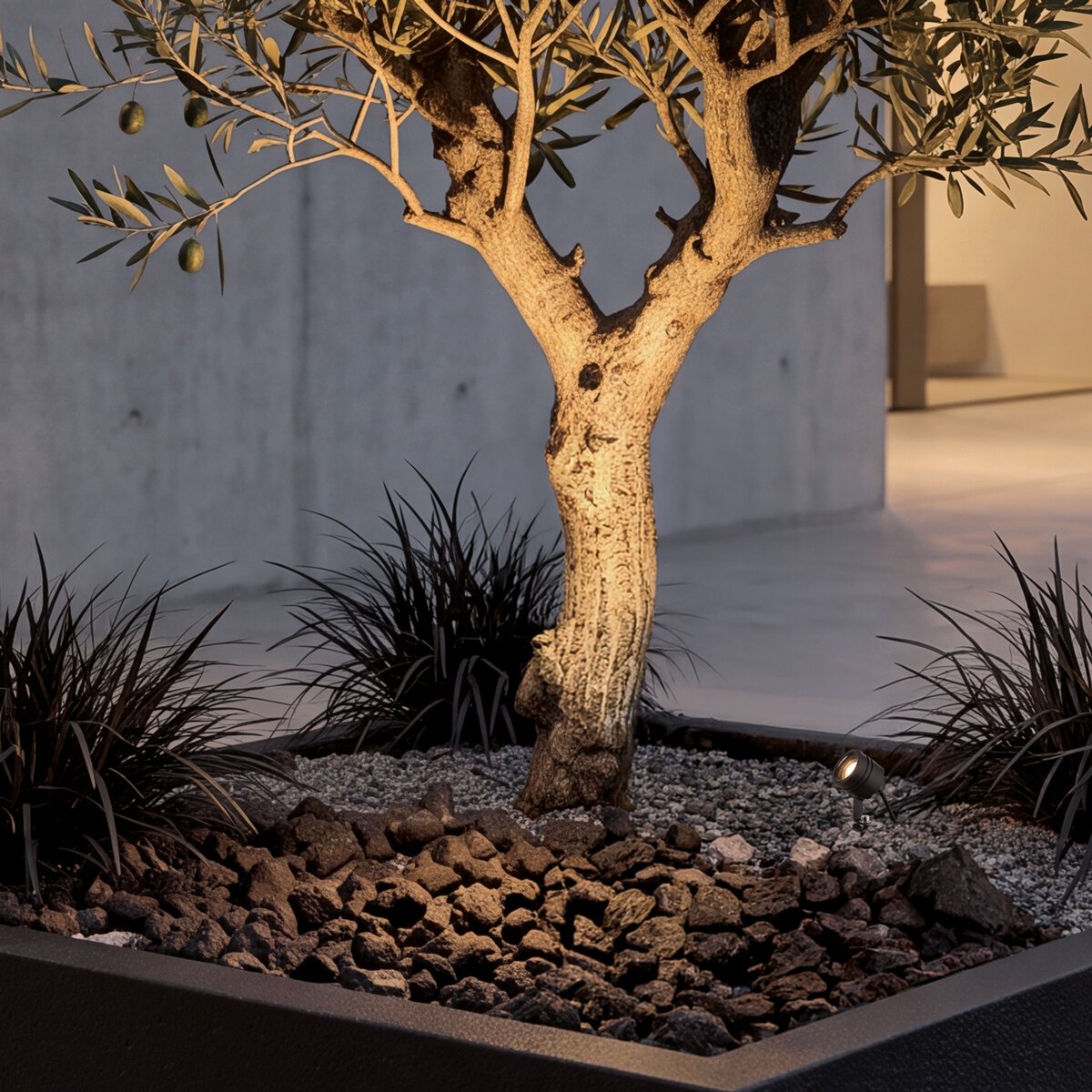
Spike lights are mainly used to pick out planting. For a tree, the light usually goes in by the trunk and points up into the canopy; for a shrub or ornamental grass it stands in front, a little way back. A garden wall or fence is lit more evenly by several lights aimed almost parallel to the surface, which brings out its texture. Because the light is staked rather than set in concrete, its position and angle are easy to change as the plants grow.
Power and output for each subject
Lights in this category range from 0.5 to 75 W and from 50 to 1860 lm. Low-power models suit a flower bed, a low shrub or the edge of a path. A tall tree or a garden wall needs a stronger light with a narrower beam. On GU10 models the bulb you fit sets the output and beam angle, so the same light can serve a small or a larger subject. In a small garden an overly bright light creates a glaring hotspot.
Protection from moisture and mowers
A spike light stands right in the soil and is splashed by rain and watering, so most models in this category are IP65, with a few at IP54. IP54 lights are best kept to sheltered, drier spots. Cable joints should be made in sealed junction boxes rather than left lying in damp soil. Where the lawn is mown, put the light just beyond the lawn edge so the mower does not catch it.
Materials and finishes
Housings are mostly aluminium, with some stainless steel, polycarbonate and acrylic parts and tempered glass lenses. Finishes are brown, anthracite, grey, black and green. Green and brown all but disappear among plants in daylight, while anthracite and black stand out and suit dark paving or a dark facade. The light is mostly 3000K, with some models at 2700K: warm light keeps the natural colour of leaves and bark.
| Subject | Where the light goes | Aim | What to look for |
|---|
| Flower bed, low planting | in front, among the plants | down or angled | a low-power model |
| Shrub | in front, a little way back | angled upwards | a medium-output model |
| Tree | beside the trunk | up into the canopy | higher output, narrow beam |
| Fence or wall | at the base | up, almost parallel to the surface | several matching lights |
Spike lights are often combined with outdoor freestanding lights along the path, outdoor recessed lights in terrace decking and outdoor wall lights on the house.