How High Should You Hang a Pendant Light and What Size to Choose?
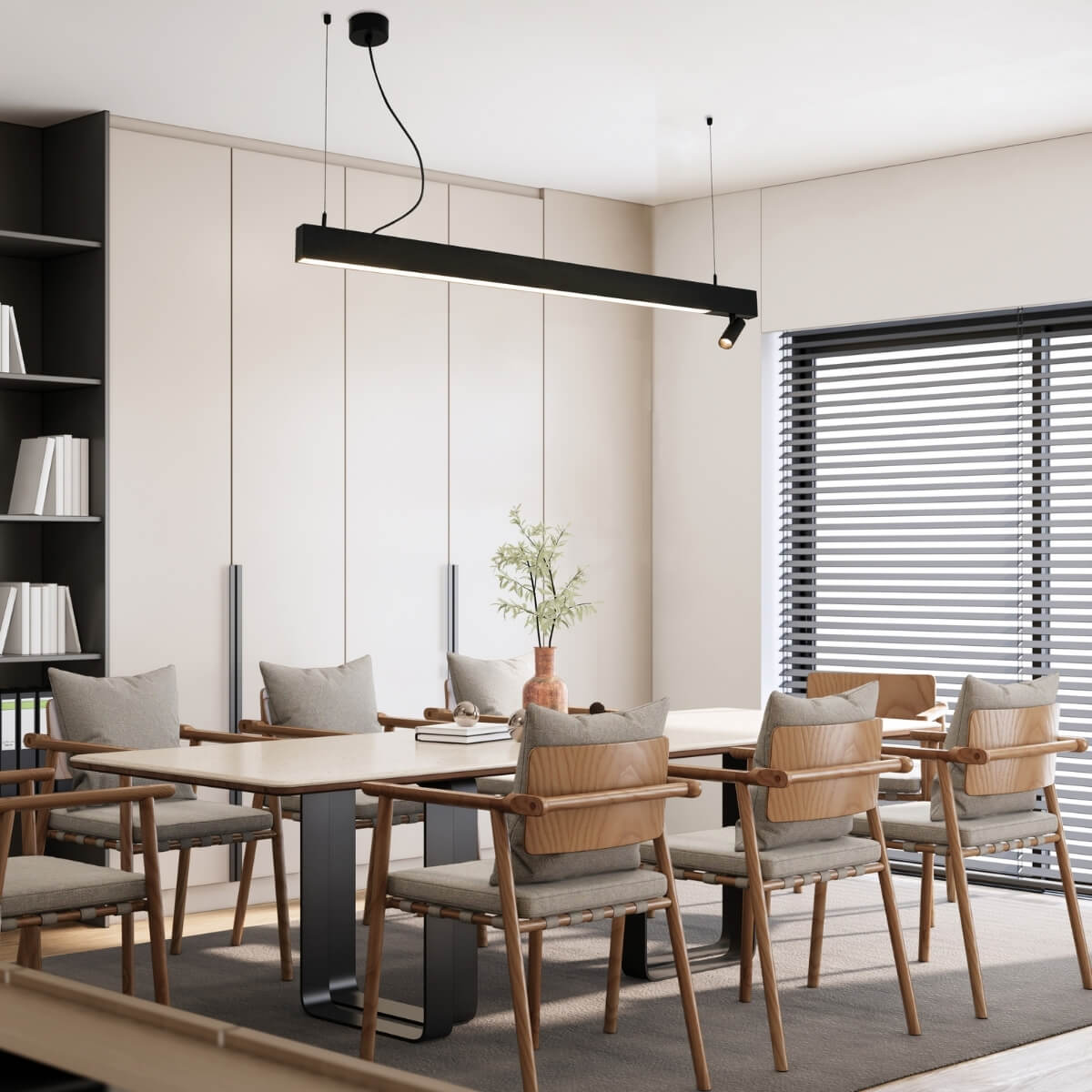
The bottom of a pendant light over a dining table or kitchen island is usually hung 70–90 cm above the surface, and in walkways no lower than about 2.1 m from the floor. The size depends on the table width: the diameter is usually about 30 cm less than the table width, roughly half to two thirds of it. This guide explains the height and size rules, how to arrange several pendants and how to adjust the cable length during installation.
What the height is measured from
Height is measured from the bottom edge of the fitting to the surface it lights, not from the ceiling. What matters is both the amount of light on the table and being able to see the people sitting across it. A pendant hung too low dazzles and blocks the person opposite, while one hung too high scatters the light and leaves the table dim.
If the ceiling is higher than the usual 2.5 m, you will need a longer suspension or cable, because the distance above the table stays the same. Always calculate from the surface rather than the ceiling, and choose a long enough suspension or cable. Before buying, check how long the supplied cable or chain is, as it cannot always be extended.
Height and size guidelines by situation
The table gives commonly used guideline values. The exact figures can be adjusted for the shape of the fitting, the light source, the table height and the height of the people using the space. For taller people and busy walkways, allow a larger clearance.
| Situation | Bottom edge above surface | Fitting size | Note |
|---|---|---|---|
| Dining table | 70–90 cm | About 30 cm narrower than the table (½–⅔ of its width) | Centre on the table axis, not the room centre |
| Kitchen island | 75–90 cm | A row of several fittings, total length up to 2/3 of the island | Spacing depends on the width of the shades |
| Walkway or stairwell | No less than 2.1 m from the floor | Narrower than the passage | Check clearance to doors and stairs |
| Living room without a table | Bottom edge no lower than 2.1 m from the floor | Proportional to the room size | High ceilings allow a longer drop |
| Beside a bed or armchair | As needed to avoid glare | Small, one fitting on each side | Make sure a head cannot touch the fitting |
How to choose the fitting size
Round and square pendants
A practical rule: the pendant diameter is usually about 30 cm less than the table width, leaving roughly 15 cm on each side. That keeps the table edges lit and stops people catching the fitting as they stand up. A table 90 cm wide therefore suits a pendant of roughly 60 cm, and a table 100 cm wide one of up to 70 cm. This matches another common guideline of half to two thirds of the table width; go smaller if you want a more restrained accent.
Linear pendants
A linear pendant is usually about half to two thirds of the table length. One that is too long overwhelms the table and is harder to clean, while one that is too short looks lost and leaves the table ends dim. Measure the table in advance and compare it with the length given in the specification.
Room proportions
In a small room a large pendant can look heavy, so choose open or light shapes. In a spacious room with high ceilings you can choose one larger fitting or several at different heights. In an open-plan space where dining meets living, a pendant also helps define the zone, so its size should match the furniture group.
Arranging several pendants over a table or island
When there are several pendants, keep the spacing even. Usually about 60–80 cm is left between centres, but it depends on the diameter. As a general rule the gap between fittings should not be larger than the fitting itself, otherwise the light breaks into separate pools.
- Two pendants usually suit a table up to about 1.6 m long, three suit a longer one.
- Whatever the number, centre the row on the table axis and keep the outer pendants at least 20–30 cm from the table ends.
- In groups of different heights, the middle fitting is usually hung highest and the outer ones lower.
It is worth checking these distances in advance by marking the positions on the ceiling with tape or a paper template. If you plan several pendants, also work out the total luminous flux with our lighting calculator, and for more general advice read How to choose the right light fixture for every room.
Adjusting the cable length during installation
Most pendants come with a long cable or chain that is shortened to the required length during installation. Before shortening, lower the fitting onto a temporary support, mark the required height and only then cut the cable or remove chain links.
- Measure the height from the floor to the tabletop, usually about 75 cm.
- Add the chosen distance to the bottom of the fitting, for example 80 cm.
- Subtract the total from the ceiling height to get the cable length including the fitting body.
- Leave a few centimetres of spare for the connection inside the ceiling canopy.
Carry out electrical work only with the circuit switched off and, if you lack experience, leave it to a qualified electrician. Heavy fittings need a suitable fixing point in the ceiling. If you are unsure about height or size, you can ask us for advice.
How this looks in our range
Our pendant luminaires category lists 699 models in a variety of shapes, with power from 2 to 174 W. Single pendants (115 listings) are most often hung over smaller tables or beside a bed. Long tables and islands suit linear lights (22 listings), some of them DALI dimmable. The Chandeliers category includes Thoro Lighting products. The main pendant brands are TK Lighting, Thoro Lighting and Zambelis.
Frequently asked questions
How high should a pendant hang over a dining table?
The bottom of the pendant over a dining table is usually hung 70–90 cm above the tabletop. With high ceilings the height above the table stays the same and only the cable is longer. If the light dazzles seated people, raise it, and if the light scatters and the table looks dim, lower it. The easiest way to test the height is to hang the pendant temporarily before final fixing.
What size pendant suits a table?
A round or square pendant is usually about 30 cm narrower than the table, which is roughly half to two thirds of its width, while a linear pendant is about half to two thirds of the table length. This keeps the table edges lit and nobody bumps into the fitting when standing up. Measure the table before buying and compare it with the fitting dimensions.
How high should a pendant hang in a walkway or stairwell?
In walkways the bottom of the pendant should be no lower than about 2.1 m from the floor, so it does not get in the way of tall people or create a hazard. In a stairwell, measure from the step a person is standing on, and add some margin so the fitting does not reach a head even when climbing higher.
How many pendants should hang over a kitchen island?
It depends on the island length and the fitting size. Two or three identical pendants, evenly spaced and centred on the island axis, usually look tidy. The total length of the row should not exceed about two thirds of the island length, and the bottom edge should be about 75–90 cm above the surface. Check the distances in advance.
Summary
The height and size of a pendant depend on the surface it lights. Over a table or island, hang the bottom edge 70–90 cm above the surface, and in walkways at least 2.1 m from the floor. The pendant diameter is usually about 30 cm less than the table width. Space several pendants evenly, centre them and mark the positions in advance. Shorten the cable only after you have measured the final height, leave the electrical work to a qualified electrician and provide a secure fixing point for heavy fittings.
Related Articles

How to Choose Bathroom Lighting: IP Ratings, Zones and Colour
Learn what the IP code means, how a bathroom is split into zones 0, 1 and 2, and which light and fittings suit the mirror, shower and washbasin.
Read more : How to Choose Bathroom Lighting: IP Ratings, Zones and Colour
How to Choose the Right Light Fixture for Every Room
How to choose a light fixture for every room: a lumens table by room, fixture sizing rules, IP ratings, common mistakes and FAQs.
Read more : How to Choose the Right Light Fixture for Every Room