How to Choose Bathroom Lighting: IP Ratings, Zones and Colour
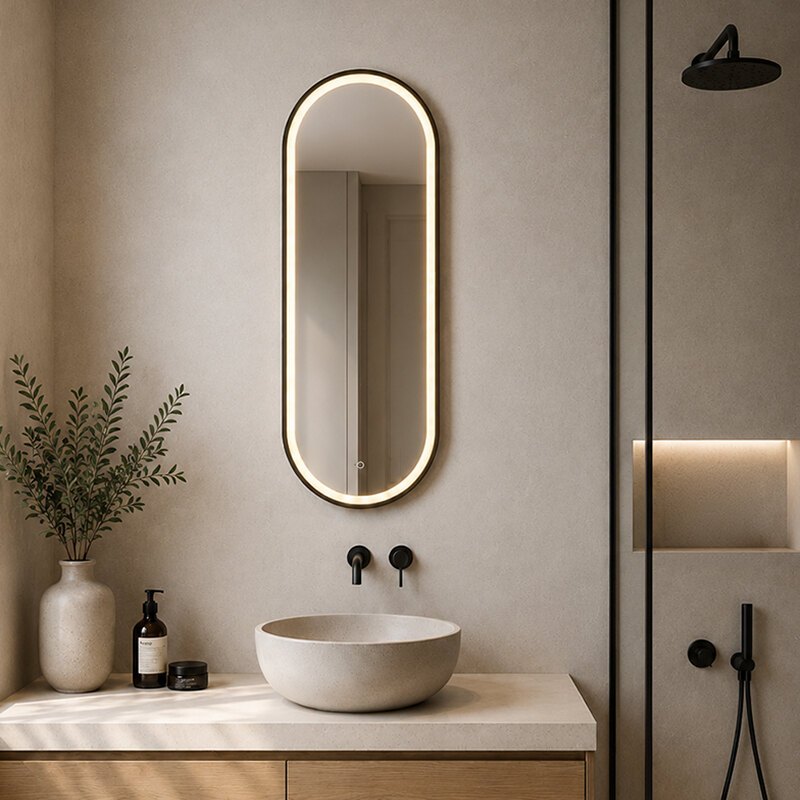
In a bathroom, choose light fittings by zone rather than by looks: above the bath or shower you should aim for at least IP65, within 60 cm around them at least IP44, and further away the risk from moisture is lower. This guide explains what the IP code means under IEC 60529, how HD 60364-7-701 divides a bathroom into zones 0, 1 and 2, which colour temperature suits a mirror and how to pick fittings for each area.
What the IP code means
IP (Ingress Protection) is the protection rating defined in IEC 60529. The code has two digits. The first shows protection against solid objects and dust (0 to 6), the second protection against water (0 to 8). If an X replaces a digit, that aspect was not tested, for example IPX5.
In a bathroom the second digit matters most. The difference between IP44 and IP65 is large: the first withstands only splashing water, the second water jets from any direction.
| Second digit | Protection against water | Where it fits in a bathroom |
|---|---|---|
| 0 | None | Dry rooms only, not near water |
| 4 | Splashing from any direction | Zone 2, areas by the washbasin |
| 5 | Water jets (6.3 mm nozzle) | Zone 1 above a shower or bath |
| 6 | Powerful water jets | Zone 1, intensive cleaning |
| 7 | Immersion up to 1 m for 30 min | Zone 0 |
| 8 | Continuous immersion | Zone 0, when the manufacturer states it |
On bathroom fittings the first digit is usually 2, 4 or 6, but the second one matters more: an IP20 fitting has no protection against water at all.
Bathroom zones 0, 1 and 2
The standard HD 60364-7-701 (IEC 60364-7-701) divides a bathroom into zones according to how close electrical equipment is to the water. The closer to the bath or shower, the stricter the requirements.
| Zone | Location | Indicative IP | What fits |
|---|---|---|---|
| 0 | Inside the bath or shower tray | IP67 | Special submersible fittings on safe extra-low voltage (SELV) |
| 1 | Above the bath or shower up to about 2.25 m | IP65 (at least IPX5) | Sealed recessed fittings made for shower areas |
| 2 | Up to 60 cm around the bath or shower | IP44 | Wall lights, illuminated mirrors, recessed fittings |
| Outside zones | The rest of the room | Usually IP20 to IP44 | Ceiling fittings, general lighting |
Exact dimensions and permitted solutions for a specific project are always set by the electrical design and the regulations in force. The table gives the indicative values most commonly followed. If you are unsure which zone applies to your bathroom, you can ask us for advice.
What to know about zones 0 and 1
In zone 0 only fittings designed for it are allowed, powered by safe extra-low voltage of no more than 12 V. This means the power supply must sit outside zones 0 and 1. In zone 1 sealed recessed fittings are the usual choice, and the housing must withstand constant exposure to moisture.
General light and light at the mirror
Bathroom lighting usually combines general light with separate light at the mirror. General light comes from recessed or ceiling fittings, while the mirror light illuminates the face. As a guide, about 200 lx is enough for general bathroom light (EN 12464-1 gives this level for washrooms), and roughly 300 to 500 lx is usually aimed for at face height by the mirror.
The face is best lit from both sides, or from above across the full width of the mirror. A single fitting above the mirror casts shadows under the brows and chin, which makes shaving or make-up awkward. An LED mirror with an integrated light strip solves this because the light spreads evenly.
Colour temperature and CRI at the mirror
In a bathroom, choose 3000 K (warm white) for general light and 3000 to 4000 K at the mirror. Warmer light feels cosier in the morning and evening, while neutral 4000 K light shows skin tones more accurately and suits anyone who needs precise make-up or shaving.
The colour rendering index matters at the mirror too. A CRI (Ra) of at least 80 is recommended for homes, and 90 or more if you apply make-up or want true skin tones. It also helps to keep every bathroom fitting at the same colour temperature, so that warm and cool light do not mix in one room.
How to choose a fitting for each zone
- Above the shower (zone 1): a sealed recessed fitting, indicatively IP65 or higher, and only if the manufacturer states it is intended for this zone.
- By the bath or washbasin (zone 2): at least IP44; wall lights, illuminated mirrors and ceiling fittings all work.
- Above the mirror: a fitting with an even diffuser, 3000 to 4000 K and a high CRI.
- The rest of the room: choose for general lighting; a moisture-resistant IP44 fitting is the safer choice even outside the zones.
Before buying, check that the IP rating applies to the whole product, not just the light source or connector, and that the fitting is meant for the exact place you plan to use it. General principles for other rooms are covered in our guide How to choose the right light fixture for every room.
How this looks in our range
The Bathroom Wall Lights category currently lists 8 fittings rated IP44 or IP54, with power from 7 to 21 W. The LED mirrors category has 13 listings with IP44 or IP54 protection and 3000 K, 4000 K or tunable (CCT) light. Recessed lighting (115 listings) includes IP44, IP54 and IP65 models, and the outdoor recessed category offers IP65 to IP68 products. All of these categories include products by Zambelis.
Frequently asked questions
What IP rating does a bathroom light need?
A bathroom light usually needs at least IP44 in zone 2 and about IP65 above the shower or bath in zone 1. Fittings beyond the 60 cm limit can have a lower rating, but in a damp room IP44 is the more practical choice. The final requirement is set by the electrical design and the regulations in force.
Can an IP44 light go above a shower?
Usually not. IP44 protects against splashes, while above a shower the fitting is hit by direct water jets and steam, so the indicative rating for zone 1 is IP65 (at least IPX5). An IP44 fitting suits areas outside this zone, such as beside the washbasin or at the mirror in zone 2. If it is unclear which zone applies to your shower enclosure, choose a higher IP rating.
Which light colour is best in a bathroom?
Most people choose 3000 K warm white because it creates a cosy atmosphere. At the mirror you can also choose 4000 K neutral light, which renders skin tones more accurately. What matters most is that all fittings in the room share the same colour temperature, with a CRI of at least 80 and ideally 90. That way faces look natural and the room feels calm and consistent.
Does an LED mirror need an IP rating?
Yes, because a mirror sits in or near zone 2, where splashes and steam occur. The indicative minimum is IP44. Before buying, check that the rating covers the whole mirror including its power supply, and that the connector and cable suit a damp room. If the mirror has a touch switch, it must meet the same IP rating.
Summary
Plan bathroom lighting by zone: IP67 and 12 V extra-low voltage in zone 0, IP65 in zone 1, IP44 in zone 2, and at least IP20 beyond, although IP44 is better in practice. At the mirror choose 3000 to 4000 K light with a CRI of at least 80, and the closer to the water you go, the more carefully you should check the product's IP rating. For more complex cases, such as a new build, it is worth consulting an electrician and checking the regulations in force.
Related Articles

How High Should You Hang a Pendant Light and What Size to Choose?
Learn how high to hang a pendant over a table, island or walkway, what size to choose and how to arrange several pendants.
Read more : How High Should You Hang a Pendant Light and What Size to Choose?
How to Choose the Right Light Fixture for Every Room
How to choose a light fixture for every room: a lumens table by room, fixture sizing rules, IP ratings, common mistakes and FAQs.
Read more : How to Choose the Right Light Fixture for Every Room